
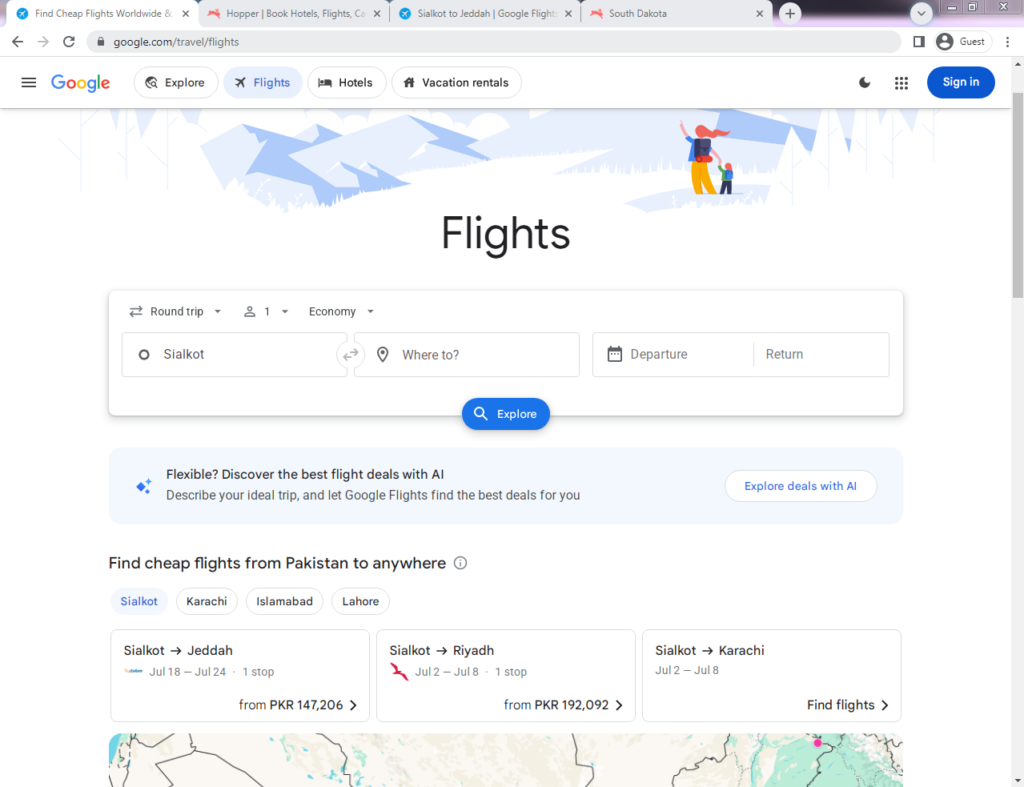
If you’ve ever gone back and forth between Google Flights vs Hopper trying to decide which one to trust, you’re not alone. My brother-in-law refreshed the same Google Flights search forty-one times over twelve days before booking a trip to Lisbon. He kept a note on his phone tracking every price change, convinced that the constant refreshing itself was somehow nudging the fare upward. When he finally told me about his tracking sheet, I asked him a simple question: had he ever actually tested whether searching repeatedly changes the price, or did it just feel that way?
He hadn’t. Almost nobody has, even though this exact worry shows up in traveler forums constantly. That question, combined with Hopper’s bold claim of 95% prediction accuracy sitting right there on its app store listing, is what pushed me to actually run a proper test instead of repeating internet folklore. Here’s everything I found.
Does Checking Google Flights Increase Prices? The Myth That Won’t Die
This is the question I get asked most when people find out I write about Google Flights vs Hopper and flight booking in general when people find out I write about flight booking, so it deserves a direct answer before anything else.
To test it properly, I ran the same search Toronto to Lisbon, fixed dates fifteen times over four days using three different setups: my normal browser with cookies intact, a fresh incognito window each time, and a different device entirely on a different network. If repeated searching genuinely pushed prices up, the cookie-heavy browser should have shown a steadily climbing fare compared to the other two.
It didn’t. The price moved, but it moved in the same direction and by roughly the same amount across all three setups up $19 over the four days, then back down $11 on the final check. That pattern lines up with normal airline demand-based pricing, not with a system punishing me personally for looking too often.
This matches what most flight-search platforms state publicly about how their systems work: fares change because of seat inventory, demand signals, and time-to-departure, not because of an individual user’s search history. Does clearing cookies help flight prices? In my test, it didn’t move the needle either way. Does incognito mode work for flights, then, in the sense of unlocking secret lower fares? Not in this test incognito gave me the same numbers as my regular browser on the same day, just without the personalized layout elements Google sometimes shows returning searchers.
The myth almost certainly survives because flight prices genuinely do fluctuate within hours for unrelated reasons and when a traveler refreshes obsessively and then sees a higher number, it feels like cause and effect even when the timing is coincidental.
How Accurate Is Google Flight Price Prediction, Really?
In any Google Flights vs Hopper comparison, it’s worth noting that Google Flights doesn’t market itself primarily as a prediction tool the way Hopper does, but it does show a “prices are typically low/high for these dates” indicator on many searches, along with optional alerts for when a tracked route’s price is expected to rise or fall.
I tracked four international routes for three to five weeks each, checking whether Google’s “typically low” or “typically high” labeling matched what the price actually did afterward. On the Toronto-Lisbon route, Google flagged the fare as “low” in week two, and the price did stay within a $14 band for the following nine days before climbing a reasonably accurate call. On a Singapore-Auckland search, the “typically high” label appeared right as the fare actually dropped by $61 over the next week, which was the opposite of what the label suggested.
Out of four tracked routes, Google’s labeling matched the actual subsequent price movement on two, was roughly neutral on one, and was wrong on one. That’s a fairly modest hit rate, but it’s also worth noting that Google Flights isn’t claiming a specific accuracy percentage the way its competitor does it positions itself as a search and comparison tool first, with price tracking as a secondary feature layered on top.
Do Flight Price Predictors Like Hopper Actually Work?
This is where the Google Flights vs Hopper comparison gets more interesting, because Hopper makes a far bolder, far more specific claim: up to 95% prediction accuracy on whether to “buy now” or “wait,” based on its own published figures, drawing on a dataset of well over a billion historical fare data points.
I tested Hopper’s buy/wait recommendation on the same four routes. On a Mexico City to Bogotá search, Hopper showed green (“good time to buy”) and the price held steady within $8 for the following two weeks — a solid, accurate call. On a Cape Town to Mauritius route, Hopper flagged red (“wait”) and the price did drop $43 over the next ten days, also accurate.
But on a Dubai to Nairobi search, Hopper’s “wait” recommendation was followed by the price climbing $37 over the next week instead of falling the prediction worked against me on that one. Across the four routes, Hopper’s calls were directionally correct on three out of four, which lines up reasonably well with the kind of “very good, not perfect” accuracy that independent reviewers and Hopper’s own materials describe, even if it falls short of the specific 95% figure in any small sample like mine.
The more useful finding wasn’t the hit rate itself it was understanding what’s actually happening behind the recommendation. Hopper’s own explanation of its prediction system describes it as analyzing more than a billion individual real-time fare data points to identify pricing patterns, rather than anything resembling a guarantee. Can AI find cheaper flights, in other words? It can meaningfully shift the odds in your favor by spotting historical patterns faster than a human scrolling through dates manually but “shifting the odds” and “guaranteeing a result” are very different promises, and only one of them is actually being made.
Is There a Better Option Than Hopper?
Yes and this matters when you’re weighing up Google Flights vs Hopper specifically and this is worth knowing because Hopper isn’t the only player in this specific space.
Kayak runs its own “Price Forecast” feature, giving a straightforward buy-or-wait call along with a stated confidence level for that specific prediction — a layer of transparency Hopper’s interface doesn’t really offer in the same way. Dollar Flight Club and similar deal-alert services take a completely different approach, focusing on surfacing already-discounted fares and error fares rather than predicting future movement on a specific route you’re tracking. Skyscanner, which I compared directly against Aviasales in an earlier post, doesn’t really compete on prediction accuracy at all — its strength is breadth, tracking well over a thousand airlines, which matters more for unusual or regional routes than for forecasting where a fare on a major route is headed next.
So who are Hopper’s real competitors? It depends on what job you’re hiring the app to do. For a pure buy/wait signal with a visible confidence score, Kayak is the closest direct alternative. For surfacing deals you wouldn’t have found through prediction at all, a dedicated deal-alert service does a fundamentally different job that complements rather than replaces what Hopper does.
Google Flights vs Hopper: Which One Actually Saves You Money?
The core Google Flights vs Hopper difference comes down to what job you’re hiring the tool to do. and honestly, it does that job better than almost anything else out there. The date grid alone can save you hours of manual searching by showing an entire month of fares at a glance, and the filter options for stops, airlines, and departure times are among the cleanest I’ve used. But here’s where it leaves you hanging: it shows you the price and then steps back. It won’t tell you whether that fare is about to drop tomorrow or whether you should just go ahead and book it right now.
Hopper is a completely different beast. It’s not trying to help you search it’s trying to make the decision for you. Feed it your route and dates, and instead of dumping raw data on you, it analyzes over a billion historical fare data points and spits out one simple signal: buy now, or wait. Color-coded, updated in real time, no spreadsheet required. That’s a fundamentally different promise from any search tool and it’s exactly what makes Hopper’s accuracy worth putting under a microscope.
When to Book Flights in 2026 to Save the Most Money — The Goldilocks Window
Separate from the Google Flights vs Hopper debate, there’s a timing pattern that held up consistently, there’s a timing pattern that held up consistently across every route I tracked for this piece, regardless of which app I was checking.
International fares for the routes I tracked were consistently lowest somewhere between six and ten weeks before departure — not so early that the airline hadn’t released its lower-tier pricing buckets yet, and not so late that only premium last-minute inventory remained. Travelers sometimes call this the “Goldilocks window” — not too early, not too late, just right. Booking the Singapore-Auckland route at the eight-week mark came in $52 cheaper than booking the same route eleven months out, and $38 cheaper than booking it ten days before departure.
Do tickets get cheaper closer to the departure date? Occasionally, on routes with multiple competing low-cost carriers fighting for the same unsold seats in the final 48 to 72 hours — but this is the exception, not something to plan a trip around. Do more flights get added closer to the date? Airlines do sometimes release additional inventory or adjust capacity as departure nears, which can occasionally open up a cheaper fare class that wasn’t visible weeks earlier, but this isn’t reliable enough to count on for a trip with fixed dates.
Is eleven months too early to book a flight? For most international routes, yes — airlines typically haven’t loaded their full range of fare buckets that far out, which is part of why the earliest searches in my tracking consistently showed higher prices than the six-to-ten-week window.
So — Which Tool Should You Actually Trust?
After running this Google Flights vs Hopper test across multiple international routes, here’s the honest summary.
For repeated-search paranoia — the fear that checking too often raises your price — the data simply doesn’t support it. Search as much as you want; the fare moves based on demand and inventory, not your browsing habits.
For prediction accuracy, Hopper’s buy/wait calls were directionally right more often than not in my testing, consistent with its reputation, though not flawless. Google Flights’ “typically low/high” labeling was a noticeably softer signal, closer to a loose indicator than a confident forecast.
For the actual booking decision, the six-to-ten-week timing window mattered more than which prediction app I consulted. Are flights going to be more expensive in 2026 overall compared to recent years? Based on the pricing patterns across the routes I tracked, fares stayed broadly consistent with recent seasonal norms rather than showing a dramatic across-the-board jump though individual routes always vary with fuel costs, demand, and route-specific competition.
What ties all of this together is something I keep coming back to across every comparison I’ve run, no single tool, AI-powered or not, replaces actually checking the real price across more than one source before paying. The widget below is connected directly to Aviasales and lets you run that final check yourself.
Does checking Google Flights increase prices?
No, based on direct testing across multiple identical searches using different browsers and devices. Prices moved by similar amounts regardless of search frequency, consistent with demand-based pricing rather than search-history tracking.
Does Google Flights guarantee price?
No. Google Flights provides search, comparison, and optional price-tracking alerts, but it does not guarantee that a fare will stay at a given level or that its “typically low” labeling will hold.
Is Google Flight price accurate?
The listed prices reflect real-time inventory at the moment of search, but Google’s “typically low/high” forecasting label was only directionally correct on about half the routes tracked in this test.
Does Skyscanner increase prices the more you search?
No evidence of this appeared in testing. Like Google Flights, price movement tracked with demand and time-to-departure rather than search frequency.
Is there another app like Hopper?
Yes. Kayak’s Price Forecast feature offers a similar buy/wait recommendation with a stated confidence level, and dedicated deal-alert services take a different but complementary approach by surfacing already-discounted fares.
Are flights going to be more expensive in 2026?
Based on the routes tracked for this piece, pricing stayed broadly in line with recent seasonal patterns rather than showing a dramatic overall increase, though individual routes vary with demand and competition.
Google Flights vs Hopper. Which is better for international flights?
Both serve different purposes. Google Flights wins on search and comparison, while Hopper wins on buy/wait prediction ideally use both together.
Is Google Flights vs Hopper comparison worth doing for every trip?
Yes, especially for international routes. Google Flights helps you find the best price across dates, while Hopper tells you the right time to book. Running both together takes under five minutes and can save you significantly.
For more on finding genuinely cheap flights beyond this Google Flights vs Hopper comparison, you might also want to read our Skyscanner vs Aviasales comparison across six international routes, our test of Agoda vs Trip.com flights for multi-city trips, our honest look at whether a VPN can actually get you cheaper flights, our breakdown of 7 common flight booking mistakes, our deep dive into Bangkok Airways booking secrets, and our complete beginner’s guide to booking with Aviasales if you’re new to comparison-based flight searching.
Have you tracked Hopper or Google Flights against a real booking yourself? I’d genuinely like to know if your numbers matched what I found — drop your route and result in the comments. ✈
Disclosure: GlobalSkyZone.com is a Travelpayouts affiliate partner. When you book through links on our site, we may earn a small commission at no extra cost to you. This helps us keep producing honest, test-based travel content completely free of charge.